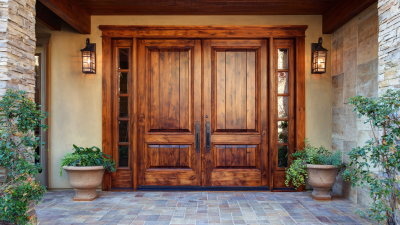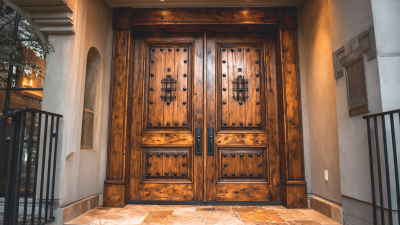
China’s wood front door manufacturers serve buyers seeking warmth, security, and dependable production at scale. The commercial opportunity is substantial. Grand View Research estimated the global doors market at USD 153.5 billion in 2022, with projected annual growth of 5.2% from 2023 to 2030. That report covers many door types and materials, not wood front doors alone. Useful context, but not a direct measure of this niche.
Material knowledge matters as much as market size. In the USDA Forest Products Laboratory’s Wood Handbook, wood scientists Samuel V. Glass and Samuel L. Zelinka describe wood as hygroscopic: it responds to moisture in its surroundings. Buyers should therefore ask about species, kiln-drying, moisture control, joinery, coatings, and packaging. A carefully finished sample can reveal grain consistency and edge details. A sales sheet cannot.
Details matter. This guide examines Chinese manufacturers through product range, customization, quality controls, export experience, and communication. It also considers practical questions, such as whether a factory can maintain finish consistency across a large order. A polished catalog is not proof of stable production. Nor does the lowest quotation tell the whole story. Global buyers should compare specifications, sample quality, lead times, and documented inspection procedures before choosing a supplier. The comparison is imperfect; factory capabilities change, and public information may be incomplete. Still, a clear checklist makes the search more grounded.
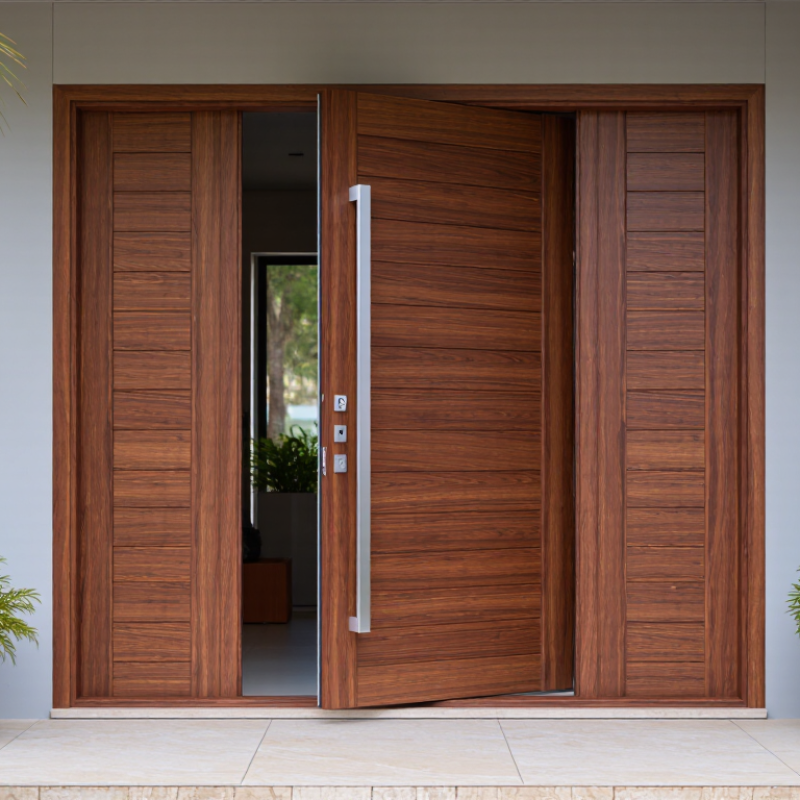
A capable wood front door manufacturer does more than shape boards and apply a finish. It can explain its timber selection, construction method, and quality checks in clear terms. Ask how the door handles seasonal humidity changes, especially if it will travel from China to a very different climate. Details matter. A stable core, well-fitted joints, and sealed edges can help limit warping and moisture entry. Request drawings, material specifications, and photos of completed work. A polished sample is useful, but it cannot prove every production batch will match. That deserves a careful check.
Reliable communication is part of manufacturing quality. Buyers should expect timely answers about dimensions, finish options, packaging, and production schedules. Clarify who checks the door before shipment and what inspection records are available. Confirm that hardware openings and installation tolerances match the project drawings. Small mismatches can mean costly adjustments on site. No factory is perfect; even a detailed process can miss a flaw. A transparent supplier should be willing to discuss corrective steps rather than promise zero risk.
Tips: Send a measured drawing and climate details before requesting a quote. Ask for a finish sample, edge-sealing photos, and written inspection criteria. Compare the actual specifications, not just the catalogue images.
Wood species influence a front door’s appearance, weight, and response to changing humidity. Oak has visible grain and a firm feel, while walnut offers darker tones and a more varied pattern. Teak naturally resists moisture, but availability and cost can differ. Small details matter. Check the wood’s moisture condition and finish, not just a sample photograph.
Designs range from simple flush doors to raised panels, glass inserts, and carved surfaces. A restrained panel layout suits many homes, while decorative carving can add character but needs careful dusting. Construction matters just as much. Solid-wood doors show natural variation and may move with seasonal changes. Engineered wood cores can improve dimensional stability when paired with suitable veneers and edge sealing. Neither option is automatically best.
Ask manufacturers how stiles, rails, and panels are joined, and whether exposed edges receive the same finish as the faces. A well-made joint should feel tight, with no obvious gaps at the corners. Request specifications for the core, thickness, finish, and hardware preparation before comparing quotes. For export projects, confirm packaging protects corners and surfaces during transit. I would not judge quality by weight alone; a heavy door can still have weak joints or uneven finishing.
Evaluating a wood front door manufacturer starts with production evidence, not a polished catalog.
Ask how many doors the facility can make each month, and whether that figure includes sanding, finishing, and inspection. A large workshop can still miss deadlines when kiln-dried timber or hardware arrives late. Request a recent production schedule and a sample inspection record. Details matter. Check whether the factory monitors timber moisture, since unstable wood may warp after installation. Ask what measuring tools workers use and how often they check them. A clear answer is more useful than a confident promise.
Product quality is visible in construction.
Inspect corner joints, panel fit, hinge reinforcement, and finish consistency under natural light. Open and close a sample repeatedly; listen for rubbing, loose hardware, or uneven movement. Ask for the timber species, core construction, coating system, and test conditions in writing. Confirm dimensions and performance needs for the intended market before production.
If samples differ from bulk orders, that gap deserves investigation. Ask how defects are recorded, repaired, and prevented from recurring. Request packaging details too: corner protection and a sealed wrap can reduce transit damage. One sample cannot prove long-term performance, so compare samples with inspection records and production checks.
For global buyers, customization should begin with the destination market, not the catalog. Specify opening size, wood species, veneer, panel layout, glazing, hardware, and finish together. A darker stain can alter appearance, while added glass or changed seals may affect tested performance. Small details matter.
Compliance is configuration-specific. For EU projects, confirm applicable Construction Products Regulation requirements and whether the product falls under a harmonised standard, such as EN 14351-1 for external pedestrian doors. In the United States, check local energy, wind, fire, and accessibility rules; test reports for one door design may not cover another. Ask for declarations, traceable material records, and reports from competent independent laboratories. Paperwork is not performance.
Responsible sourcing also deserves scrutiny. FAO’s Global Forest Resources Assessment 2020 estimated that forests cover about 4.06 billion hectares, or 31% of global land area. That scale makes species identification and documented sourcing practical procurement checks, not decorative claims. Request the botanical species, origin, moisture-control process, and finish specifications. Review a physical sample under the project’s lighting. It may still differ slightly from the finished door. That is worth discussing before production.
Buying a wood front door from China involves more than comparing the quoted unit price. Ask suppliers to separate the door, finish, hardware, export packing, and transport costs. Provide exact opening dimensions, swing direction, wood preference, and finish requirements before requesting a firm quote. Otherwise, a low price may leave important items out. Small details add up.
For shipping, confirm the production timeline, packing method, delivery term, and who handles freight, insurance, and destination charges. Ask for photos of the packed door and its protective corners before dispatch. Wood can be sensitive to moisture and handling, so sturdy packaging matters. Check local import costs and delivery access with your freight provider; a large crate may need special unloading arrangements. Keep records.
After-sales support should be agreed in writing, not left to a friendly promise. Clarify inspection standards, warranty coverage, response times, and the process for reporting transit damage or missing parts. Keep order documents and clear photos of any issue. Even with careful checks, finish color can look different under home lighting, and measurements sometimes need a second review. Cross-border fixes may take time, so confirm what remedies are available before placing the order.

5960 Odana Road
Madison, WI 53719
T: 608.442.0032
1001 Frank H Street
Waunakee, WI 53597
T: 608-268-7140