What Are the Top China Modular Trade Show Booths? This guide examines the Chinese suppliers shaping portable, reusable exhibition spaces. It focuses on design quality, structural flexibility, production control, and support after delivery.
A strong Modular Trade Show Booth should do more than look polished in photographs. It should arrive accurately packed, assemble without unnecessary tools, and remain stable under busy show-floor conditions. We will compare aluminum framing, fabric graphics, counters, lighting, storage, and transport cases. We will also consider customization, lead times, installation services, and transparent pricing. Small details matter. A loose connector can delay an entire setup.
Trade show strategist Barry Siskind has written, “A trade show is a face-to-face medium.” That idea remains important when evaluating China-based booth manufacturers. Digital previews cannot fully show fabric tension, edge finishing, lighting brightness, or the feel of a locking system. Experienced buyers should request technical drawings, material samples, previous project photographs, and clear production milestones. Compliance documentation and venue requirements also deserve careful review.
The top suppliers are not always the cheapest. They usually balance creative planning with dependable manufacturing and practical logistics. Some excel at lightweight systems, while others provide larger custom structures with stronger visual impact. No ranking is perfect. Supplier performance can vary by project, deadline, and communication quality. This comparison therefore looks beyond attractive renders. It considers what buyers may discover during shipping, installation, dismantling, and repeated use. The goal is a realistic view of China’s Modular Trade Show Booth market, including its strengths, limitations, and areas that require closer inspection.
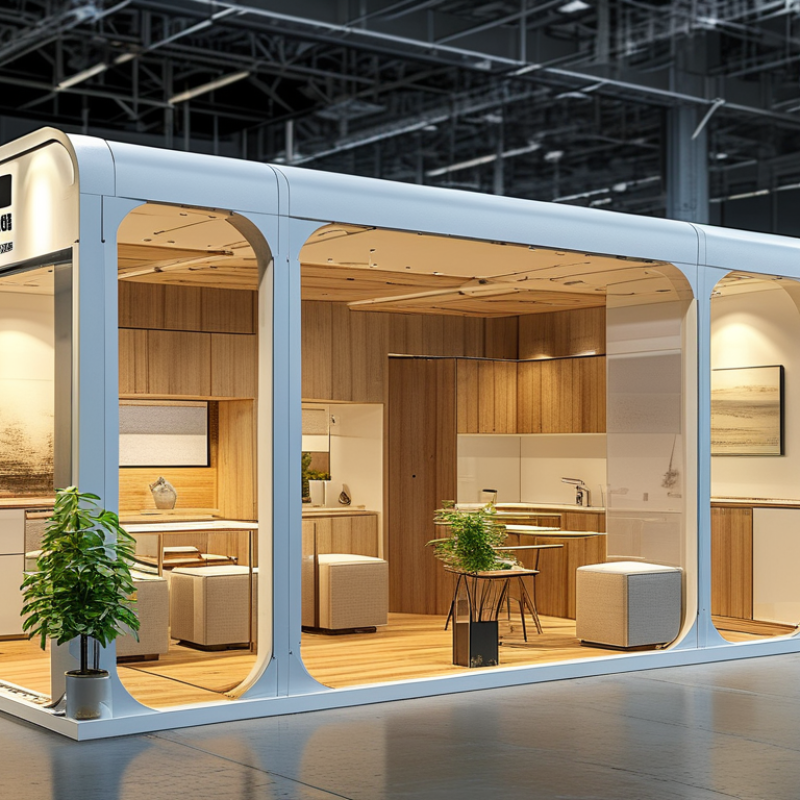
China-made modular booths usually use aluminium frames, tension fabric graphics, laminated panels, and tool-free connectors. These systems pack into reusable cases and adapt to 10-square-meter or 100-square-meter spaces.
The strongest designs separate structure from decoration. A frame can serve several exhibitions. Graphics, shelves, lights, and counters can then change. International Aluminium Institute data states that recycled aluminium requires about 5% of the energy used for primary aluminium. That makes durable aluminium attractive, but only when the frame returns to service.
Reuse is measurable. A credible fabricator should report component reuse by count, weight, and exhibition cycle. For example, a 70% reuse rate may count ten repeated panels, while ignoring discarded graphics and damaged fittings. That number can mislead. UFI’s 2024 Global Exhibition Barometer identifies sustainability as a continuing priority, yet it does not provide one universal booth reuse benchmark. Buyers should request packing records, material specifications, replacement rates, and photographs from later installations.
The practical test is simple. Can two workers rebuild the booth without special tools? Do hinges survive repeated loading? Are fabric graphics replaceable without changing the frame?
These details separate a modular system from a temporary kit. Cheap is not circular. A low purchase price may hide weak connectors, mixed materials, or poor after-sales support. China-made booths vary widely, and inspection remains necessary. Certified fire performance, electrical documentation, and clear recycling instructions should accompany every serious quotation.

What Are the Top China Modular Trade Show Booths?
Which Booth Formats Lead? Compare 3×3 m, 6×3 m, and Custom Designs
China’s modular trade show booths work best when format matches visitor behavior. UFI’s Global Exhibition Barometer reported that more than half of surveyed companies expected exhibition activity to grow. That signals stronger competition for attention. A 3×3 m booth offers a compact footprint, quick installation, and lower transport demands. It suits first-time exhibitors or brands testing one product line. However, two staff members, a counter, and a screen can quickly make it feel crowded.
The 6×3 m format provides 18 square meters for clearer zoning. One side can display products, while another supports demonstrations and private conversations. CEIR research identifies lead generation as a major exhibition objective, so accessible meeting space matters. The extra depth also allows discreet storage. That small detail improves daily operation. Still, a larger booth does not automatically create better results. Poor lighting or oversized graphics can waste the advantage.
Custom modular designs lead when a company needs unusual product sizes, suspended signage, or reusable components. Industry reports from UFI repeatedly connect exhibition performance with investment conditions and audience quality, not floor area alone. My practical preference is a flexible 6×3 m system for established exhibitors. Yet that judgment can be wrong. A focused 3×3 m booth may outperform it with sharper messaging and better staff engagement. Custom construction deserves review when the layout must adapt across several Chinese exhibitions.
Booth size directly affects display capacity and visitor flow. A 3×3 m modular booth provides 9 m², while a 6×3 m booth doubles the area to 18 m². Custom designs have no fixed standard size; the chart uses a 6×6 m, 36 m² reference layout to show how a larger custom footprint can support additional meeting, storage, and product-display zones.
When ranking China modular trade show booth suppliers, do not judge only by polished renders or low quotations. ISO 9001 is a useful starting point because it shows a documented quality management system. Ask for the certificate, issuing body, validity dates, and covered production address. Then check whether procedures reach cutting, printing, packing, and on-site installation.
Look for evidence, not promises. A reliable supplier should provide inspection records, material specifications, packing photos, and corrective-action reports. CE marking matters when electrical products or other regulated components are included. It confirms applicable European conformity requirements, but it is not a general quality award. Verify the declaration, product scope, and test documents carefully. Small details matter.
UFI-related recognition can indicate familiarity with professional exhibition practices, but its scope must be confirmed. Is it membership, an event-service credential, or documented compliance with specific guidance? These are not identical. Request recent project references, measured delivery times, and a sample project schedule. Ask how the team handles missing panels, damaged graphics, or late venue access. Their answer reveals operational maturity.
A practical scorecard might assign 30% to ISO 9001 evidence, 20% to CE documentation, 20% to UFI-related credibility, and 30% to project execution. Still, certificates can hide weak workmanship. I once valued paperwork too highly and overlooked unclear installation responsibilities. That mistake is worth remembering. Inspect samples, confirm responsibilities in writing, and compare evidence against actual booth performance.
| Ranking Dimension | Relevant Standard or Reference | Objective Requirement | Weight | Scoring Method | Acceptable Evidence |
|---|---|---|---|---|---|
| Quality management system | ISO 9001:2015 | A valid certificate should identify the legal entity, certified site, scope of activities, certificate number, issue date, expiry date, and certification body. | 25% | 5 = certificate independently verified and scope covers design or manufacture; 3 = certificate supplied but scope is limited; 0 = no valid evidence. | Current ISO 9001 certificate and certification-body verification record. |
| Product conformity and safety | Applicable EU CE legislation | CE marking applies only when the supplied product falls under relevant EU harmonised legislation. Electrical lighting, power supplies, and electronic components may require conformity assessment; a bare aluminium frame normally does not receive CE marking solely because it is a booth frame. | 20% | 5 = correct declaration and technical file for applicable products; 3 = partial component documentation; 0 = unsupported or misleading CE claim. | EU Declaration of Conformity, test reports, product identification, and applicable technical documentation. |
| UFI industry standing | UFI membership and event-industry references | UFI is a global exhibition-industry association. UFI membership or participation can support industry credibility, but it is not a product-quality certification and should not replace technical verification. | 10% | 5 = status independently confirmed through official UFI records; 3 = verifiable industry references without UFI status; 0 = unverifiable claim. | Official membership listing, event references, client references, or documented exhibition projects. |
| Structural engineering and load safety | Project-specific engineering practice and local venue rules | The supplier should provide layout drawings, connection details, declared loads, ballast requirements, hanging-point information, and venue approval documents where required. | 15% | 5 = stamped or professionally reviewed calculations and venue-ready drawings; 3 = basic drawings only; 0 = no engineering documentation. | Structural drawings, load calculations, installation method statement, and venue approval records. |
| Fire and material documentation | Destination-country and venue fire regulations | Graphics, fabric, foam, flooring, timber, and plastics should be documented against the fire classification required by the destination venue or jurisdiction. | 10% | 5 = current reports match the exact materials supplied; 3 = generic reports require confirmation; 0 = no fire documentation. | Material-specific fire-test reports, certificates, technical datasheets, and venue acceptance records. |
| Modularity and reuse | Procurement and lifecycle evaluation | A strong modular system should support tool-efficient assembly, interchangeable panels, reconfiguration, replacement graphics, and documented spare-part availability. | 10% | 5 = multiple documented configurations and spare parts; 3 = limited reconfiguration; 0 = mainly single-use construction. | System catalogue, assembly drawings, sample bill of materials, and spare-part policy. |
| Delivery and installation capability | Project service-level requirements | The supplier should define production milestones, packing standards, shipping responsibilities, installation resources, contingency planning, and post-event dismantling arrangements. | 5% | 5 = documented end-to-end process and local installation plan; 3 = partial logistics support; 0 = buyer manages all execution risks. | Project schedule, packing list, logistics plan, installation method statement, and service contacts. |
| Recommended ranking interpretation | 100% | 90–100: preferred shortlist | 75–89: qualified with conditions | 60–74: additional due diligence | below 60: high procurement risk | |||
Note: ISO 9001, CE, and UFI address different aspects of supplier evaluation. Always verify certificate validity, product scope, destination-country requirements, and venue-specific rules before placing an order.
For a China modular trade show booth, compare the complete cost, not only the USD/m² quote. A practical purchase range is about USD 180–450/m² for an aluminum frame, panels, flooring, lighting, and basic graphics. Rental usually costs 55–75% of purchase pricing. Premium finishes increase the figure quickly. Freight may add 8–18% when shipped by sea, while urgent air freight can cost much more. Setup, dismantling, local labor, electricity, rigging, and venue handling fees are often excluded.
The UFI Global Exhibition Barometer 2024 reported continued pressure from labor, logistics, and operating costs across exhibitions. CEIR industry research also confirms that face-to-face events remain important for B2B marketing. These reports do not provide one universal booth price. That matters. My first estimate is often wrong when venue rules appear late. A realistic budget should include a 15–20% contingency, especially for overseas shows. Freight volume matters more than booth weight in many cases. A compact 36 m² booth may ship in several crates, with packaging affecting the final bill.
Request three separate quotations: production, logistics, and onsite services. Ask whether prices include fire-rated materials, installation drawings, storage, and graphic replacement. Check the venue’s official manual before approving the design. A lower USD/m² price can hide expensive electrical or handling charges. Photograph every crate before dispatch. Small details prevent costly surprises.
A top modular trade show booth should meet your schedule before impressing visitors. Request a detailed production timeline, including design approval, fabrication, inspection, packing, and shipping. Add a realistic buffer for customs and venue deadlines. In my experience, unclear approval stages create more risk than complex booth designs. Ask for dated progress photos, material samples, and a written remedy for delays.
Carbon performance needs measurable evidence. Compare the booth’s weight, packaging volume, transport distance, and reusable components. Aluminum frames, fabric graphics, and tool-free connectors can support repeated use. However, “reusable” does not automatically mean low carbon. A heavy structure shipped by air may cancel its environmental benefit. Request material weights, reuse estimates, and shipping options. Third-party documentation helps, but verify what each certificate actually covers.
ROI should connect booth spending with business results. Track total cost, qualified leads, meetings, follow-up opportunities, and eventual gross profit. A simple estimate is useful: expected gross profit from converted leads divided by total booth cost. It is not perfect. Sales cycles change, and some leads are difficult to attribute. Still, consistent tracking improves future decisions.
Tips:

5960 Odana Road
Madison, WI 53719
T: 608.442.0032
1001 Frank H Street
Waunakee, WI 53597
T: 608-268-7140