Choosing the best Solid Surface Counter Top requires more than comparing colors or showroom samples. A beautiful slab must also handle daily cooking, cleaning, moisture, and occasional impact. Material composition matters. Acrylic surfaces often provide smoother repairs and more consistent seams. Polyester blends may offer strong color depth and competitive pricing. Neither option is perfect.
A reliable evaluation should examine the countertop’s thickness, edge construction, warranty, and fabrication quality. Run your hand across a sample. The surface should feel even, without ripples or visible casting marks. Place a warm mug nearby, but do not treat the counter as heatproof. Hot pans can damage many solid surface materials. Ask the fabricator how seams are joined and repaired. Poor installation can undermine an otherwise excellent product.
Consider the room, too. A busy family kitchen needs stain resistance and simple maintenance. A bathroom may prioritize moisture protection and integrated sinks. Light colors can make a small room feel larger, yet they may reveal coffee rings more quickly. Dark finishes look dramatic, but scratches can become more noticeable under strong lighting. This is where personal experience can challenge product claims. Marketing photos rarely show years of use.
The best Solid Surface Counter Top is the one that matches your habits, budget, and installer’s skill. Compare certified specifications, request physical samples, and inspect completed projects before deciding. Leave room for honest uncertainty. A careful choice usually outperforms a fashionable one.
A solid surface countertop is a manufactured worktop made from mineral fillers and acrylic or polyester resins. The material is usually formed into sheets, then cut and joined during installation. Unlike natural stone, it has a consistent color throughout. Its nonporous surface resists spills, stains, and everyday moisture. Cleaning is simple. Warm water and mild soap are often enough.
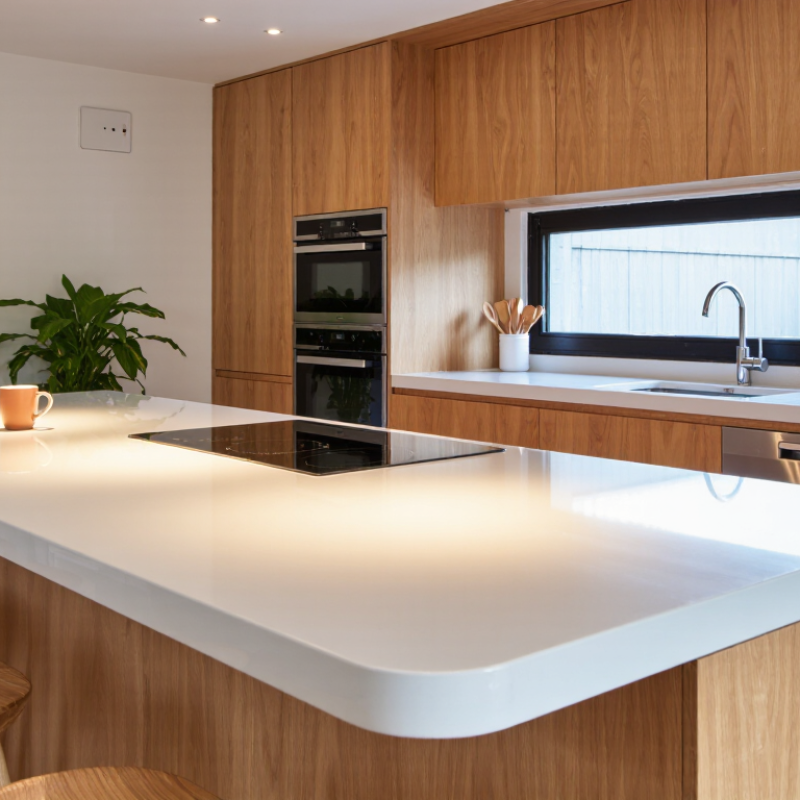
The most noticeable feature is the joint. Skilled installers can create nearly seamless connections around sinks, corners, and backsplashes. This detail gives the counter a smooth, furniture-like appearance.
Solid surface can also be shaped with heat, allowing curved edges and integrated sinks. Small scratches may be sanded away, which is useful in busy kitchens and bathrooms. It is not indestructible, though. Hot pans can damage the surface, and sharp objects may leave marks. Use trivets and cutting boards.
A practical installation depends on accurate support and careful measurement. Poorly supported sections can flex or separate over time. I would not choose this material based on color alone. Edge design, sink placement, and daily habits matter just as much.
Some homeowners expect a stone-like surface, then feel disappointed by its softer texture. That reaction is fair. Solid surface offers repairability and design flexibility, but it needs reasonable care. Even a well-made countertop can show wear when treated carelessly.
What Is the Best Solid Surface Counter Top?
How Solid Surface Countertops Are Made and Classified
A 2024 Grand View Research report estimated the global solid surface market at about 4.5 billion dollars. It also projected steady growth through 2030. However, market forecasts differ by research method. That gap deserves caution.
Solid surface begins as a resin, mineral filler, pigments, and curing agents. Manufacturers blend these materials, cast or press them into sheets, then heat and finish the surfaces. Acrylic-rich sheets usually offer better thermoforming and repairability. Polyester-rich sheets often provide stronger color depth and lower material costs. These are useful tendencies, not absolute rules.
Classification usually considers resin family, filler content, thickness, color pattern, and fabrication performance. The ANSI/ICPA SS-1 specification provides industry guidance for solid surfacing materials. NSF/ANSI 51 can also matter when counters contact food in commercial environments.
On a jobsite, installers cut the sheet with carbide tools. They bond seams with matched adhesive, then sand them through several abrasive grades. A good seam should disappear under normal lighting. It may still reveal itself under harsh side lighting. Integrated sinks and curved edges are possible because the material softens with controlled heat. Poor heating can create stress marks or distortion.
The best choice depends on use, not appearance alone. Examine repair needs, heat exposure, seam placement, and local fabrication skill. I would not treat a glossy sample as proof of long-term performance. Real kitchens are messier.
| Dimension | Classification or Key Data | How It Is Made or Evaluated | Typical Performance | Best Use or Selection Guidance |
|---|---|---|---|---|
| Basic Definition | Non-porous, homogeneous countertop material | Manufactured as a solid sheet rather than as a thin decorative layer over a separate core. Seams can usually be bonded and sanded to create a visually continuous surface. | Low liquid absorption and no natural stone fissures or open grain | Suitable for kitchens, bathrooms, healthcare areas, laboratories, reception desks, and other spaces requiring easy cleaning. |
| Main Composition | Acrylic-based, polyester-based, or blended resin with mineral filler and pigments | Resin is combined with mineral fillers, commonly alumina trihydrate or similar mineral materials, along with colorants and performance additives. | Composition affects workability, appearance, repairability, heat behavior, and color consistency. | Choose a formulation according to the intended use instead of judging the material by color alone. |
| Acrylic-Based Solid Surface | Resin system primarily based on acrylic polymers | Cast or molded into sheets and then cut, routed, thermoformed, and joined with compatible adhesive. | High repairability and strong thermoforming potential | Often preferred for curved edges, integrated sinks, seamless installations, and designs requiring extensive fabrication. |
| Polyester-Based Solid Surface | Resin system primarily based on polyester polymers | Mineral filler and pigments are mixed with polyester resin, formed into sheets, cured, and finished. | Good color depth and generally strong visual gloss potential | Appropriate when appearance and selected decorative effects are more important than extensive thermoforming. |
| Blended Resin Solid Surface | Combination of acrylic and polyester resins | Uses a mixed resin system to balance fabrication characteristics, appearance, and material performance. | Performance depends on the specific formulation and manufacturing process. | Review the technical specifications, fabrication instructions, and warranty conditions before selection. |
| Manufacturing Process | Mixing, casting or molding, curing, trimming, sanding, and surface finishing | Mineral filler, resin, pigments, and additives are blended, shaped into sheets, cured, calibrated to thickness, and finished for fabrication. | Controlled production can provide consistent thickness and repeatable color within a product series. | Inspect sheets for warping, surface defects, shade variation, and damage before installation. |
| Appearance Classification | Solid color, particulate, veined, translucent, or textured appearance | Visual effects are created by pigments, mineral particles, decorative chips, or patterned manufacturing techniques. | Solid colors may show scratches more clearly; particulate and veined patterns can visually reduce minor marks. | For busy areas, medium-value colors and subtle patterns are often easier to maintain visually. |
| Porosity and Hygiene | Non-porous surface when properly fabricated and maintained | The continuous resin-rich surface does not rely on a penetrating sealer for routine protection. | Very good resistance to liquid penetration and routine staining | Useful where cleanability is important. Clean spills promptly, especially strongly pigmented or acidic substances. |
| Seams | Bonded, sanded, and blended joints | Sections are joined with color-matched adhesive, then the joint is leveled and finished by a qualified fabricator. | Properly fabricated seams can be less noticeable than mechanical joints, although they are not always completely invisible. | Request a seam layout that avoids high-stress areas and aligns joints with cabinet support where practical. |
| Integrated Components | Integrated sinks, backsplashes, drainboards, and edge details | Matching solid-surface pieces are shaped and joined to the countertop during fabrication. | Creates a continuous, easy-to-clean transition with fewer exposed joints | Well suited to wet areas and contemporary designs with minimal visual breaks. |
| Scratch Resistance | Moderate; surface can be scratched by sharp or abrasive objects | The material is workable with standard woodworking tools, which also means it is not scratch-proof. | Minor scratches can often be removed or reduced by professional refinishing; deeper damage may require repair. | Use cutting boards, avoid dragging cookware, and do not use abrasive pads for routine cleaning. |
| Heat Resistance | Moderate, not equivalent to a heat-proof surface | Resin-based materials can discolor, deform, or crack when exposed to high or prolonged heat. | Hot cookware, appliances, or heat sources may cause permanent damage without protection. | Always place hot pots, pans, slow cookers, and countertop appliances on trivets or heat-resistant pads. |
| Impact Resistance | Good for normal residential and commercial use, but not impact-proof | Performance depends on sheet thickness, edge profile, cabinet support, cutouts, and installation quality. | Heavy impacts at corners, unsupported overhangs, and cutouts may cause chips or cracks. | Use adequate support, especially around sinks, cooktops, seams, corners, and extended overhangs. |
| Repairability | Generally high compared with many rigid slab materials | Minor scratches, dull areas, and some burns can often be sanded and refinished. Cracks and chips may require patching by a professional. | Good potential for surface renewal and localized repair | Choose this material when long-term maintainability and the possibility of refinishing are priorities. |
| Maintenance | Routine cleaning with mild soap, water, and a soft cloth | Because the surface is non-porous, routine care generally does not require sealing or polishing compounds. | Low daily maintenance; avoid harsh solvents, strong acids, and abrasive cleaners unless approved by the material specification. | Clean spills promptly and follow the fabricator's care instructions for the specific finish. |
| Fabrication Flexibility | High machinability and design flexibility | Can be cut, routed, drilled, edge-shaped, thermoformed in suitable formulations, and bonded with compatible adhesives. | Supports custom edges, curves, backsplashes, and integrated features | A strong option for custom layouts, curved counters, accessible designs, and seamless visual details. |
| Installation Requirements | Accurate templating, sound cabinet support, expansion allowance, and professional seam work | Panels are installed over a stable, level substrate or cabinet framework. Cutouts and overhangs require appropriate reinforcement. | Poor support or incorrect cutouts can lead to stress, cracking, or seam failure. | Use an experienced fabricator and confirm support requirements before cabinets are finalized. |
| Environmental Considerations | Long service life; recyclability and recycled content vary by formulation | Some products include recycled mineral or resin content, while end-of-life recycling options depend on local facilities and material composition. | Durability and repairability can reduce replacement frequency, but resin content should be considered in sustainability assessments. | Ask for verified recycled-content information, indoor-air-quality documentation, and local end-of-life options. |
| Overall Selection Profile | Best for seamless design, hygiene, customization, and repairability | Its main advantages come from homogeneous construction, non-porosity, integrated fabrication, and the ability to refinish the surface. | Balanced performance for design-focused and high-cleanability applications | Choose solid surface when seamless appearance and repairability matter more than maximum heat and scratch resistance. |

What Is the Best Solid Surface Counter Top?
The best countertop depends on how your kitchen works each day. For busy family kitchens, acrylic solid surface offers seamless joints and easy repairs. Small scratches can often be sanded away. Its smooth, nonporous finish also resists everyday spills. However, hot pans can leave marks, so trivets remain necessary.
Quartz suits cooks who want strong stain resistance and consistent color. It handles coffee, tomato sauce, and frequent cleaning with little maintenance. It is not completely heatproof, despite its durability. Place a hot skillet on a protected pad. I have seen careless heat exposure create a dull, permanent patch.
Granite performs well for homeowners who prefer natural variation and strong heat resistance. Each slab has different mineral patterns, so samples may mislead you. Some surfaces need periodic sealing, especially around sinks and food preparation areas. Porcelain offers excellent resistance to heat, ultraviolet light, and staining, but sharp impacts can chip exposed edges. Its installation requires accurate support and experienced fabrication.
For a compact kitchen, seamless acrylic may provide the easiest long-term repair. For heavy cooking, quartz or granite can offer better resistance to daily abuse. For outdoor or sunlit areas, porcelain deserves serious consideration. Think about edges, sink cuts, cleaning habits, and repair access before choosing. My own preference changes with the household; the prettiest surface is not always the most forgiving.
How to Compare Durability, Maintenance, Cost, and Design
Choosing the best solid surface counter top requires more than matching a color to cabinets. In kitchen assessments, I compare daily habits, sink placement, and edge details before discussing price. A nonporous surface resists stains and supports simple cleaning. Warm water and mild soap usually handle coffee, oil, and sauce.
Durability depends on thickness, support, seams, and installation quality. A skilled fabricator can create nearly invisible joints, but poor alignment remains obvious under side lighting. Minor scratches may be sanded by a qualified professional, extending the counter’s service life. Deep cuts and repeated heat exposure still require repair.
I once underestimated a busy family’s chopping routine. The finish showed marks within months.
Cost includes more than the material itself. Measure labor, sink cutouts, backsplash work, edge profiles, delivery, and possible repairs. Simple layouts often reduce waste and installation time. Complex curves and large islands increase fabrication costs.
Design flexibility remains a major advantage, with integrated sinks, custom colors, and smooth matte finishes. Yet samples can mislead. A pale gray may look calm in a showroom but appear cold beneath blue lighting.
View samples beside cabinets and flooring, preferably in natural light. For heavy baking or frequent hot-pan use, confirm heat limitations before choosing the final surface.
What Is the Best Solid Surface Counter Top?
Choosing the best solid surface countertop starts with how your space is used. A busy kitchen needs a nonporous, easy-clean surface with carefully planned seams. Many acrylic solid surfaces can be joined almost invisibly, shaped around sinks, and repaired after light scratches. That matters in real homes. A dropped pan can still leave damage, though. Solid surface is not indestructible.
Color also changes practical performance. Pale, matte finishes usually make small kitchens feel brighter and hide minor marks better than glossy, dark finishes. Ask for a full-size sample, not a small chip. Place it beside your cabinets, flooring, and window light. I once judged a sample under showroom lighting; daylight revealed a much cooler undertone. That mistake is easy to repeat.
Review the technical sheet for heat resistance, stain behavior, warranty limits, and repair procedures. The 2024 Houzz U.S. Kitchen Trends Study reported engineered quartz as the selected countertop material in 39% of renovated kitchens, showing strong demand for low-maintenance surfaces. However, quartz and solid surface are different materials, so popularity should not decide your choice. The NKBA 2024 Kitchen Trends Report likewise highlights durability, cleanability, and integrated design as important kitchen priorities. Ask the fabricator about seam placement near dishwashers and sinks. Check the sink support details, too. Local installation quality often matters more than the showroom display.

5960 Odana Road
Madison, WI 53719
T: 608.442.0032
1001 Frank H Street
Waunakee, WI 53597
T: 608-268-7140