China Top 10 Fiberglass Exterior Door Manufacturers
Choosing reliable fiberglass exterior doors requires more than comparing attractive catalog photos. This guide introduces China’s top 10 fiberglass exterior door manufacturers and explains what makes each company worth considering. The review focuses on manufacturing experience, product quality, customization, export capability, and after-sales support.
In practical terms, buyers should examine door skins, core materials, weather seals, hinges, glazing systems, and finish durability. A well-built door should close smoothly, resist moisture, and remain stable through seasonal temperature changes. Factory experience also matters. Manufacturers with organized production lines, documented inspections, and international project records often provide more dependable results. Certifications and test reports can support confidence, but they should be verified rather than accepted without question.
No ranking is perfect.
Supplier selection also depends on the project. A coastal home may need stronger corrosion resistance, while a residential developer may prioritize stable pricing and delivery capacity. Sample doors can reveal details that product sheets hide, including edge finishing, surface texture, lock alignment, and packaging quality. Communication is another useful measure. Clear drawings, accurate quotations, and responsive technical answers usually indicate better cooperation.
This overview presents fiberglass exterior doors from a professional and practical perspective. It does not treat company size as the only sign of reliability. Instead, it considers evidence from production capabilities, quality control, customization services, and buyer experience. Some information may change over time, so responsible buyers should confirm specifications directly with each manufacturer. That small step can prevent costly misunderstandings before production begins.
China’s Fiberglass Door Sector: 10 Manufacturers Across 3 Main Product Segments
China Top 10 Fiberglass Exterior Door Manufacturers
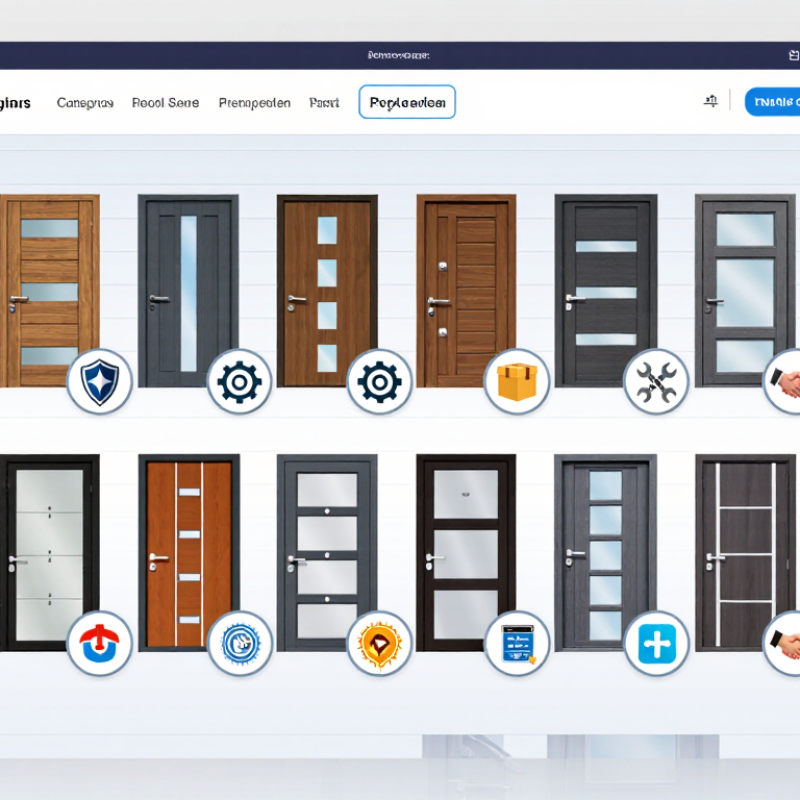
China’s fiberglass door sector includes ten notable manufacturers across three main product segments. The first segment serves residential projects, producing insulated entry doors with woodgrain textures, raised panels, and decorative glass. These factories often support standard sizes, private-label orders, and moderate production volumes. Their practical strengths include stable molding, controlled paint finishing, and packaging designed for long-distance shipping.
The second segment focuses on commercial and multi-unit buildings. These manufacturers typically supply fire-rated assemblies, reinforced frames, weather-resistant thresholds, and doors tested for repeated opening cycles. Buyers should verify test reports, hardware compatibility, and installation tolerances instead of trusting product photos. Small details matter. A three-millimeter gap can affect sealing performance.
The third segment covers custom and project-based manufacturing. It includes oversized doors, special colors, narrow sightlines, and entrance systems matched to architectural drawings. Experienced suppliers can provide shop drawings, sample corners, and production inspections before shipment. Factory visits remain useful, although remote audits can reveal material records and process controls. Rankings are not fully objective. Production capacity, quality consistency, engineering support, and after-sales response may change between projects. Some manufacturers look strong during sampling but perform less evenly at scale. Careful buyers should compare fiberglass skins, core density, adhesive coverage, coating thickness, and moisture protection before signing a purchase agreement.
Top-10 Ranking Criteria: Quality, Capacity, Certifications, Exports, and Lead Time
China Top 10 Fiberglass Exterior Door Manufacturers
A credible top-ten ranking needs more than product photographs and factory claims.
Quality should receive the highest weight, including dimensional stability, water resistance, surface consistency, and hardware performance. ASTM test records and third-party inspection reports offer stronger evidence than catalog language. The U.S. Department of Energy identifies doors as part of a building’s thermal envelope, so measured U-factor and air leakage matter in real projects.
Production capacity comes next.
Reviewers should verify monthly output, curing space, automated lines, and quality-control staffing. A large workshop is not enough. The ISO Survey 2023 recorded more than one million ISO 9001 certificates worldwide, showing certification is common, but not automatically decisive. Auditors should examine certificate scope, expiry dates, and whether the factory actually controls the listed process.
Export experience can be checked through customs records, destination coverage, packaging tests, and repeat-order evidence.
UN Comtrade data helps compare international trade flows, although it does not prove individual factory quality. Lead time deserves separate scoring: sample approval, tooling, production, inspection, and port delivery should be measured in calendar days. A practical ranking might assign 30% to quality, 20% to capacity, 20% to certifications, 15% to exports, and 15% to lead time. This weighting is imperfect. Large exporters may still miss small-batch deadlines. Buyers should request recent shipment records and inspect one finished door before signing a long-term agreement.
Fiberglass Door Performance: U-Factor, R-Value, Air Leakage, and Water Resistance
When comparing China’s top 10 fiberglass exterior door manufacturers, performance data deserves more attention than showroom styling. A door can look solid and still leak heat. The U-factor measures heat flow through the complete door assembly. Lower values generally indicate better insulation, but published figures should identify glass, frame, and test conditions. That detail matters. R-value describes resistance to heat transfer, although door listings may use different calculation methods. Ask for tested assembly results, not a single center-panel number.
Air leakage is felt around the perimeter, especially on windy winter days. Look for tested rates at stated pressure levels, and inspect weatherstripping, corner seals, and threshold adjustment. Small gaps matter. Water resistance depends on drainage paths, sill design, seals, and installation accuracy. A reliable evaluation should reference standardized laboratory testing, field installation guidance, and clear warranty terms. Laboratory results are useful, but they cannot erase poor flashing or an uneven opening. This is where many comparisons become too optimistic.
For a practical shortlist, record U-factor, R-value, air leakage, and water test pressure in one table. Then compare like with like. Request dated test reports and confirm whether values apply to the selected size and glazing package. Installer feedback often reveals performance problems before owners see them. Still, field experience is not a substitute for verified data. A carefully sealed fiberglass door can feel quiet and stable, yet real performance depends on the whole opening, not the slab alone.
China Top 10 Fiberglass Exterior Door Manufacturers - Fiberglass Door Performance: U-Factor, R-Value, Air Leakage, and Water Resistance
| Performance Profile |
Typical Fiberglass Door Construction |
U-Factor
(Btu/h·ft²·°F) |
Approx. R-Value
(°F·ft²·h/Btu) |
Air Leakage
(cfm/ft² at 1.57 psf) |
Water Resistance |
Common Test References |
| 01 |
Insulated fiberglass slab with polyurethane foam core and compression weatherstripping |
0.20–0.28 |
3.6–5.0 |
≤ 0.30 |
Typically tested at 5.0 psf; no uncontrolled water penetration during a passing test |
NFRC 100, NFRC 400, ASTM E547 |
| 02 |
Fiberglass slab with high-density polyurethane core and adjustable sill |
0.18–0.25 |
4.0–5.6 |
≤ 0.20 |
Commonly evaluated at 5.0–7.5 psf, depending on the complete door assembly |
NFRC 100, NFRC 400, ASTM E331 |
| 03 |
Fiberglass door with insulated glass panel, foam core, and dual perimeter seals |
0.24–0.32 |
3.1–4.2 |
≤ 0.30 |
Pass/fail performance depends strongly on glazing, sill, and frame design |
NFRC 100, NFRC 400, ASTM E547 |
| 04 |
Smooth fiberglass exterior slab with thermal-break threshold and sill pan |
0.19–0.27 |
3.7–5.3 |
≤ 0.20 |
Often specified for moderate-exposure applications at approximately 5.0 psf |
NFRC 100, NFRC 400, ASTM E331 |
| 05 |
Textured fiberglass slab with reinforced edge, polyurethane core, and three-point sealing |
0.20–0.29 |
3.5–5.0 |
≤ 0.30 |
Water penetration testing is normally performed on the fully assembled and installed unit |
NFRC 100, NFRC 400, ASTM E547 |
| 06 |
Fiberglass entry door with low-emissivity glass, insulated core, and multi-fin weatherseal |
0.22–0.30 |
3.3–4.6 |
≤ 0.30 |
Typical target is no visible leakage under the selected ASTM water test pressure |
NFRC 100, NFRC 400, ASTM E331 |
| 07 |
Wide-stile fiberglass door with insulated core, perimeter gasket, and weather-resistant sill |
0.23–0.31 |
3.2–4.4 |
≤ 0.30 |
Performance varies with slab size, glazing area, sill drainage, and installation quality |
NFRC 100, NFRC 400, ASTM E547 |
| 08 |
Decorative fiberglass door with insulated decorative glass and compression seals |
0.26–0.34 |
2.9–3.9 |
≤ 0.30 |
Glazing and perimeter joints are the principal water-resistance considerations |
NFRC 100, NFRC 400, ASTM E331 |
| 09 |
Energy-focused fiberglass slab with thicker polyurethane core and insulated frame option |
0.15–0.22 |
4.5–6.7 |
≤ 0.20 |
Higher water-test pressures may be specified for enhanced-exposure assemblies |
NFRC 100, NFRC 400, ASTM E547 |
| 10 |
Heavy-duty fiberglass exterior door with reinforced core, continuous weatherstrip, and drained sill |
0.18–0.27 |
3.7–5.6 |
≤ 0.20 |
Designed for reliable drainage and resistance to wind-driven rain when properly installed |
NFRC 100, NFRC 400, ASTM E331 |
Technical note: U-factor and R-value are related but are not direct substitutes. U-factor represents heat-transfer rate for the complete tested door assembly; a lower value indicates better thermal performance. Approximate R-values shown above are calculated as 1 ÷ U-factor and should not be treated as certified whole-door ratings. Air-leakage and water-resistance results depend on the complete door, frame, sill, glazing, hardware, installation, and test conditions.
Manufacturer Comparison: Materials, Core Types, Sizes, Finishes, and Warranty Terms
China Top 10 Fiberglass Exterior Door Manufacturers
Comparing leading fiberglass exterior door manufacturers requires more than checking catalog prices. A fiberglass skin should resist moisture, dents, and seasonal movement. Resin quality matters, especially around the lower edge. Some manufacturers use wood-composite frames, while others combine fiberglass with reinforced polymer or steel components. Core selection also changes performance. Polyurethane foam offers strong insulation, polystyrene reduces cost, and mineral-based cores may improve fire resistance. However, published thermal values need careful verification. Real installation conditions can reduce them.
Sizes deserve equal attention. Standard slabs may range from 30 to 42 inches wide, while custom heights often require separate engineering approval. Ask about tolerances, hinge preparation, sill height, and frame squareness. Small errors become obvious during installation. Finishes usually include smooth paintable surfaces, wood-grain embossing, factory paint, or protective stains. Request a physical sample. Digital colors can mislead.
Warranty terms reveal manufacturing confidence, but they are rarely simple. Check coverage for cracking, delamination, discoloration, hardware, glass, and frame movement. Some warranties exclude coastal exposure, poor drainage, unauthorized finishing, or incorrect installation. That matters. A long warranty may offer less protection than a shorter, clearer one. From a technical review perspective, the strongest comparison combines laboratory data, installer feedback, and documented service response. I would not rely on marketing language alone. One weakness remains: public specifications are sometimes incomplete, so buyers should obtain written confirmation before ordering.