China has become an important sourcing destination for conductive elastomers used in electronics, automotive components, and industrial equipment. For global buyers, choosing among Conductive Rubber manufacturers requires more than comparing unit prices. Material formulation, electrical resistance, compression behavior, and environmental durability can all affect performance after installation.
A useful supplier review starts with the application. A shielding gasket around an enclosure may need different conductivity and compression characteristics than a flexible contact in a control panel. Ask manufacturers for technical data sheets, test methods, sample availability, and clear explanations of how production batches are controlled. Details matter. A resistance figure without its test conditions can be difficult to compare. Buyers should also check manufacturing capabilities, communication practices, lead times, and experience with similar component geometries. A polished catalog helps, but it is not proof of consistent output.
This guide examines practical ways to evaluate Chinese suppliers, from material options and quality documentation to sampling and long-term cooperation. It also highlights questions worth asking before a specification becomes a purchase order. No single checklist can replace testing under real operating conditions, and supplier claims deserve verification. That takes time. Even experienced sourcing teams can overlook a small mismatch between a datasheet and the finished part. Careful comparison helps buyers reduce avoidable uncertainty and identify a manufacturer suited to their technical and commercial requirements.
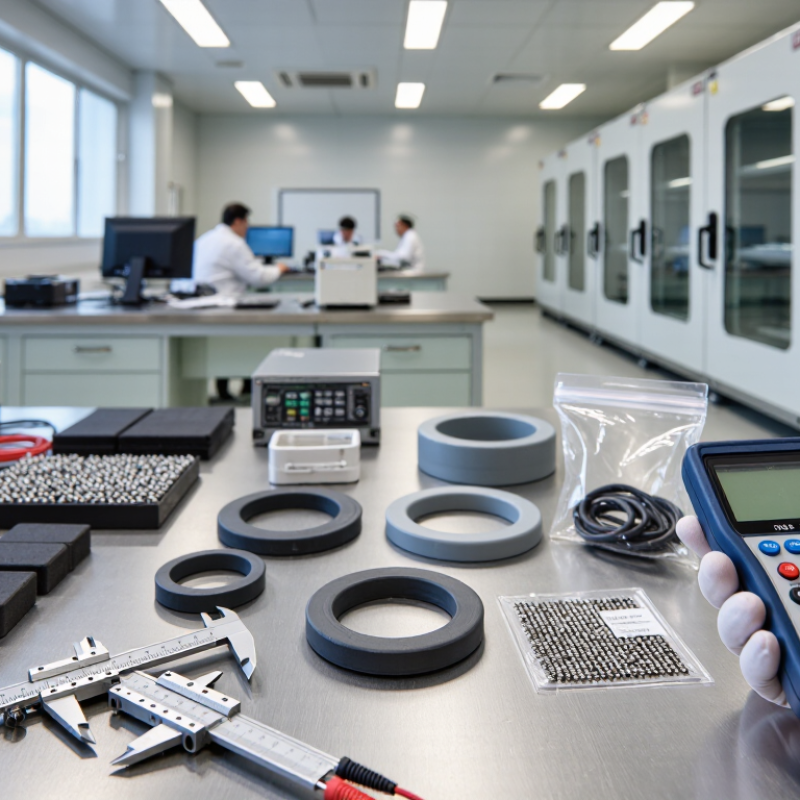
Conductive rubber is an elastomer blended with conductive particles, such as carbon or metal-coated fillers. The rubber provides flexibility; the particles create electrical pathways when they touch or sit close together. Under compression, these pathways can connect across a gasket, helping carry current and shield electronic enclosures from electromagnetic interference. Small gaps matter. A rough flange or uneven bolt pressure can interrupt contact, even when the material itself is conductive.
Designers check electrical resistance, compression behavior, and shielding performance under conditions close to real installation. ASTM D991 describes a method for measuring the volume resistivity of conductive rubber, but one test result cannot predict every joint. Thickness, surface finish, compression, and aging all affect performance. The details are easy to underestimate. Humidity and repeated compression may also change contact quality over time.
The market context is growing: Grand View Research estimated the global electromagnetic interference shielding market at about USD 7.4 billion in 2023 and projected a 5.5% compound annual growth rate from 2024 to 2030. This figure covers shielding technologies broadly, not conductive rubber alone. For buyers, the practical question is whether a gasket maintains reliable contact in the actual assembly—not just whether its datasheet reports conductivity. There is room for better validation here. Testing a prototype after installation can reveal problems that material samples miss.

Conductive rubber is used where electrical contact and environmental sealing must coexist. Manufacturers in China supply molded gaskets, strips, and custom profiles for electronic enclosures, control panels, and communications equipment. In a metal cabinet, a conductive gasket can bridge the seam and help limit electromagnetic interference while resisting dust and moisture. Small gaps matter. The compound may use silicone or another elastomer with conductive fillers, such as carbon or metal-coated particles. Filler choice affects conductivity, compression, corrosion resistance, and cost. Buyers should check test conditions, not just headline resistance figures.
Automotive applications include sensor housings, control modules, and battery-system enclosures, where seals must handle vibration and temperature changes. Conductive rubber also appears in grounding contacts for industrial instruments and selected medical-device assemblies. Each use has different demands: a soft profile may seal well but lose contact under low compression. That trade-off is easy to overlook. Material samples, aging tests, and dimensional checks can reveal issues before production, though results depend on the actual enclosure design. A supplier’s technical support and batch consistency deserve the same attention as the initial quotation. No single compound fits every application.
Conductive rubber combines an elastomer with conductive fillers such as carbon black, graphite, or metal-coated particles. Silicone suits heat-resistant seals; EPDM handles weather exposure, while nitrile rubber can suit oil-contact environments. The right choice depends on the fluid, temperature, and required electrical path. Grand View Research valued the global silicone market at USD 18.4 billion in 2022 and projected 6.7% annual growth through 2030. That broader market trend matters because silicone is a common base material for conductive elastomers, though it does not measure conductive rubber alone.
Manufacturing changes performance. Compression molding works well for shaped gaskets and small production runs. Extrusion creates continuous strips, while injection molding can support complex, repeatable parts. Filler loading affects conductivity, flexibility, and surface quality. More filler may lower resistance, but can make a seal harder and less elastic. Custom specifications should state dimensions, hardness, target resistance, operating temperature, and contact pressure. Test the finished part in its actual assembly; flat-coupon readings can mislead. For aerospace applications, NASA’s outgassing guidance cites ASTM E595 screening limits of 1.0% total mass loss and 0.1% collected volatile condensable material. One weakness in many briefs is vague wording such as “high conductivity.” It sounds useful, but gives manufacturers little to verify.
| Comparison Dimension | Common Options and Facts | Buyer Considerations |
|---|---|---|
| Elastomer Base | Silicone is commonly selected for a broad temperature range and weather resistance. EPDM is often used for outdoor water and ozone exposure. Fluorosilicone can be considered where fuel or oil resistance is important. | Confirm operating temperature, fluids, UV exposure, compression requirements, and the exact compound formulation. |
| Conductive Fillers | Formulations may use carbon-based fillers, nickel-coated graphite, silver-plated particles, or other metal-coated fillers. Filler choice affects conductivity, density, cost, corrosion behavior, and mechanical properties. | Match the filler system to shielding needs, contact materials, environmental conditions, and budget; request data for the specific compound. |
| Electrical Performance | Surface resistivity, volume resistivity, and EMI shielding effectiveness are different measurements. Results depend on formulation, specimen preparation, frequency, geometry, and test method. | Specify the required electrical metric and test conditions. Compare results measured using the same method rather than relying on an unspecified “conductivity” figure. |
| Manufacturing Processes | Common processes include compression molding, transfer molding, injection molding, and calendering or extrusion for suitable profiles and sheet forms. Curing conditions are compound- and process-dependent. | Choose a process based on part geometry, tolerances, production volume, surface finish, and tooling requirements. |
| Available Product Forms | Typical forms include molded gaskets, sheets, strips, cords, and custom-profile seals. Some designs combine conductive and non-conductive sections. | Provide drawings, dimensions, installation details, and any requirements for splices, corners, or conductive contact surfaces. |
| Customization Options | Customization may cover elastomer type, filler system, hardness, color, cross-section, thickness, tolerances, adhesive backing, and die-cut or molded geometry. | Identify which characteristics are critical and which can vary. Ask for a prototype or sample approval before production tooling is finalized. |
| Mechanical Properties | Hardness, tensile strength, elongation, compression set, and compression-deflection behavior depend on the complete compound and test conditions. Conductive fillers can change the mechanical feel and flexibility. | Request compound-specific test data and evaluate sealing force, recovery, and durability in the intended assembly. |
| Testing and Documentation | ASTM D257 is commonly used for DC resistance or conductance of insulating materials, ASTM D2240 for durometer hardness, and ASTM D412 for vulcanized rubber tensile properties. The applicable method depends on the product and specification. | Agree on methods, sample conditioning, acceptance criteria, inspection records, and any material compliance documentation before ordering. |
| Quality and Supply Evaluation | A useful evaluation may include compound traceability, process controls, dimensional inspection, electrical testing, batch consistency, and packaging requirements. | Request a technical data sheet, inspection plan, sample report, lead-time estimate, and confirmation of how production changes are controlled. |
Note: Values and performance depend on the specific compound, part design, test method, and application. Verify requirements with the supplier using representative samples and agreed test conditions.
Global buyers should assess a conductive rubber supplier beyond its quoted price. Ask how the material’s conductivity, hardness, and compression set are tested. Request recent test reports and confirm that measurements match your application’s requirements. A gasket that performs well on paper may behave differently after repeated compression. Fit matters.
Review the supplier’s production controls, not just its sample parts. Ask how it manages material batches, mixing records, and dimensional checks. For custom parts, share a drawing and discuss tolerances, tooling, and inspection methods before ordering. Check whether the supplier can explain test results clearly and respond to technical questions. Real production reveals more. A polished report helps, but it cannot prove every part will perform consistently.
Tips: Send a sample drawing and ask for a first-article inspection report. Compare the stated test method with your own acceptance criteria. Keep written records of agreed material properties and dimensions. One sample is useful, but it is not a full quality assessment. Supplier reviews can also miss problems that appear only after installation, so plan practical validation where possible.
Global buyers evaluating conductive rubber manufacturers should check export documents alongside product specifications. Ask for a consistent invoice, packing list, origin details, and product classification for the destination market. Confirm that test reports identify the exact compound and production batch. Requirements vary by destination, so verify them before production. Small details matter.
Plan for delays, not just quoted transit times. The World Bank’s 2023 Logistics Performance Index reports an average of 44 days for shipments to travel from an exporter’s warehouse to the destination port. This is a useful benchmark, not a delivery promise. Agree on packaging, shipment milestones, and who handles customs queries. For rubber sheets or molded parts, request moisture protection and clear carton labels. A neat packing list alone cannot prevent damage.
After-sales support should be specific. Set expectations for response times, replacement assessments, and access to retained batch samples. Keep records of resistance, hardness, and dimensional checks linked to each shipment. If a defect appears, photos and batch numbers help both sides investigate. But a fast reply is not the same as a good fix. Ask how corrective actions are documented and verified before placing repeat orders.

5960 Odana Road
Madison, WI 53719
T: 608.442.0032
1001 Frank H Street
Waunakee, WI 53597
T: 608-268-7140