Choosing the best Pdlc Window Film from China requires more than comparing online prices. The real test begins with a sample.
ResearchAndMarkets projects strong growth for the global smart glass sector through 2030. Grand View Research also reports rising demand in buildings, vehicles, retail spaces, and healthcare facilities. However, these reports often combine PDLC, electrochromic, and suspended-particle technologies. Their figures should not be treated as exact PDLC Window Film sales.
Performance matters at the window. Check switching speed, visible haze, light transmission, voltage stability, and adhesive clarity. A good sample should change evenly, without cloudy edges or dark patches. Ask Chinese manufacturers for independent test reports, electrical safety documents, UV-resistance results, and production traceability. Factory experience matters too. A low quotation can hide weak electrodes, inconsistent thickness, or poor after-sales support.
Dr. John Song, a recognized smart-film industry specialist, has stated, “The quality of smart film is determined by its materials, control system, and installation discipline.” That point is easy to overlook. The film is only one part of the system.
A reliable supplier should explain glass compatibility, transformer specifications, warranty limits, and replacement procedures. Site installation should include clean surfaces and carefully sealed edges. I have seen attractive samples perform poorly after careless installation. That possibility deserves attention.
The best Chinese product is not automatically the cheapest. It is the one with repeatable testing, clear documentation, stable switching, and accountable technical support. Buyers should compare verified performance, not impressive photographs. There is no perfect choice. There is only a better-documented one.
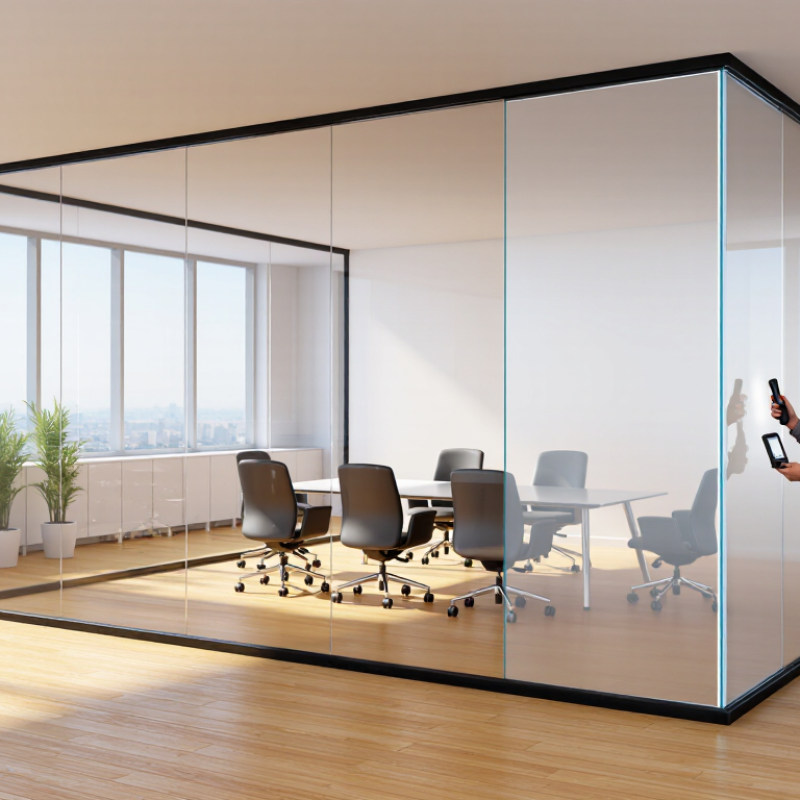
PDLC window film uses polymer-dispersed liquid crystals to control privacy with electricity. The film contains microscopic liquid-crystal droplets inside a polymer layer. When power is off, the crystals scatter light and create a frosted appearance. When power is on, they align and allow light to pass through more clearly. The change usually takes less than a second, although temperature and film quality can affect performance.
In practical installations, PDLC film is placed between glass surfaces or applied to existing glass with suitable adhesive. A transformer and controller supply the required alternating current. Good products should provide even switching, stable transparency, clean edges, and reliable wiring. For buildings in China, installers should also check humidity, glass size, indoor temperature, and the location of the power controller. These details often matter more than a brochure’s claimed haze percentage.
The best PDLC window film depends on the application, not only the price. A conference room may need fast switching and frequent daily operation. A bathroom may require stronger moisture protection and carefully sealed edges. I have found that poor surface preparation can cause bubbles, dust marks, or uneven bonding. That problem is easy to underestimate. Users should request electrical specifications, sample testing, warranty terms, and installation guidance before purchasing. Privacy film also reduces visibility, but it does not replace curtains or security glass in every situation.

The best PDLC window film from China should be judged by measurable performance, not attractive samples. Switching speed matters in meeting rooms, clinics, and shopfronts. A practical target is switching within one to three seconds, with stable operation after repeated cycles. Clear-state visible light transmission should be verified, not guessed. Many projects need more than 70% transmission for daylight. Privacy-state haze must also be tested under different lighting conditions.
Energy performance deserves equal attention. The International Energy Agency reported in Buildings 2023 that buildings consume about 30% of global final energy. The U.S. Department of Energy states that windows can cause 25–30% of residential heating and cooling energy use. Therefore, buyers should request solar heat gain data, ultraviolet rejection, and insulation results. Film thickness, adhesive quality, and edge sealing affect long-term reliability. Small details matter.
Ask for independent laboratory reports, production samples, and cycle-test records. Testing should reference recognized methods, such as ISO 9050 or EN 410, where applicable. Electrical safety documents should match the installation market. A reliable supplier should explain voltage, power consumption, controller protection, and maintenance needs clearly. Some specifications look impressive but lack test conditions. That is a warning.
Durability remains difficult to judge from brochures. Heat, humidity, and frequent cleaning can expose weak adhesive layers. I would inspect a full-size sample for bubbles, uneven switching, and visible wiring. The “best” film may not be the darkest or cheapest. It is the one whose performance survives real rooms, real users, and several imperfect installation decisions.
| Evaluation Dimension | Recommended Benchmark for a High-Quality PDLC Film | Why It Matters | How to Verify It |
|---|---|---|---|
| Switching Mode | Transparent when powered; opaque or translucent when power is off. | Provides controllable privacy while supporting natural daylight when visibility is required. | Check the film in both operating states and confirm uniform switching across the entire panel. |
| Visible Light Transmittance | Approximately 75% or higher in the transparent state; typically about 55%–75% in the privacy state, depending on construction. | Higher transparent-state transmission improves daylighting and reduces the need for artificial lighting. | Request spectrophotometer data for the complete glass-film assembly, not film alone. |
| Haze in Transparent State | Preferably 5% or lower for applications requiring a clear view. | Low haze gives a sharper image and a more glass-like appearance when the film is switched on. | Review haze measurements based on an accepted optical test method and inspect the film under side lighting. |
| Switching Speed | Approximately 1–5 seconds for transparent-to-privacy switching and about 3–10 seconds for privacy-to-transparent switching, subject to size and temperature. | Fast, consistent switching improves user experience in offices, hotels, healthcare rooms, and meeting spaces. | Test a full-size sample at the intended ambient temperature and record several consecutive cycles. |
| Privacy Performance | Uniform milky appearance with no obvious clear patches, edge halos, or visible electrode patterns. | Consistent opacity is essential for confidential discussions and visually demanding architectural projects. | Inspect the complete installation from multiple angles and under different lighting conditions. |
| UV Protection | At least UV blocking in the high-nineties is commonly preferred for interior protection. | Helps reduce ultraviolet exposure that can contribute to fading of furnishings, finishes, and displayed materials. | Ask for wavelength-specific transmittance data and clarify whether the result applies to the full glazing system. |
| Infrared and Solar Control | Consider infrared rejection or a separate solar-control layer when heat reduction is a project priority. | PDLC primarily provides privacy; it should not automatically be treated as a complete solar-control solution. | Review total solar energy transmittance, solar heat gain coefficient, and thermal data for the complete assembly. |
| Operating Voltage | Many systems operate with low-voltage AC output, commonly around 48–65 V AC after transformer conversion. | A correctly matched power supply supports stable switching and helps simplify electrical planning. | Confirm rated voltage, frequency, transformer output, wiring requirements, and electrical protection measures. |
| Energy Consumption | Typically low continuous consumption while transparent, often specified in the range of about 3–8 W/m², depending on the system. | Low operating demand can support efficient privacy control, although the actual energy balance depends on the building. | Request measured consumption at the specified voltage and compare it with the power supply capacity. |
| Electrical Safety | Use a properly insulated transformer, protected wiring, reliable connectors, and documented electrical test results. | Safe electrical integration is critical because the film is installed on large conductive glass surfaces. | Check insulation, dielectric-strength, grounding, over-current, and installation documentation. |
| Adhesive and Edge Sealing | Optically clear adhesive with clean edges and moisture-resistant edge protection suitable for the installation environment. | Good bonding and sealing reduce bubbling, delamination, moisture ingress, and edge failure. | Inspect sample edges, review adhesive specifications, and confirm the recommended cleaning and sealing procedure. |
| Durability and Cycle Life | A strong product should provide documented switching-cycle testing and a clear warranty; cycle claims should be supported by test conditions. | Long-term stability reduces maintenance and replacement costs in frequently used spaces. | Request accelerated-aging, temperature-humidity, and switching-cycle reports for the actual film structure. |
| Fire and Building Compliance | Select a product with fire-performance documentation appropriate for the destination market and building type. | Compliance may be required for commercial, public, healthcare, hospitality, and high-rise projects. | Verify test reports, classification scope, product thickness, substrate, and whether the report applies to the final assembly. |
| Film Thickness and Installation Quality | Common constructions are approximately 0.35–0.50 mm, with accurate cutting, clean lamination, and controlled installation conditions. | Thickness and workmanship affect optical clarity, handling, edge appearance, and service life. | Measure the delivered material, inspect for inclusions and scratches, and use an approved installation checklist. |
| Customization and Control Integration | Support for wall switches, remote controls, dimming or zoning where required, and compatibility with building-control systems. | Flexible control improves usability and enables separate privacy zones in larger installations. | Test the controller, zoning, fail-safe behavior, and compatibility with the project’s electrical and automation systems. |
| Technical Support and Warranty | Prefer clear installation instructions, documented quality control, traceable batches, responsive technical support, and a written warranty. | Reliable documentation and after-sales support are as important as optical performance for project success. | Review warranty exclusions, replacement procedures, lead times, inspection standards, and sample approval records. |
Note: Performance ranges are general industry benchmarks and can vary with film construction, glass type, panel size, temperature, power supply, installation quality, and testing method. Always evaluate a full-size sample and request project-specific test documentation.
The best Chinese PDLC window film is not defined by price alone. Compare measurable performance, production control, and after-sales reliability. Fortune Business Insights reported that the global smart glass market reached about USD 5.43 billion in 2023. This growth attracts capable factories, but also inconsistent suppliers. Ask for tested visible-light transmittance, haze, switching time, power consumption, and insulation performance. Request values for both laminated glass and film samples. They can differ significantly.
Practical testing often reveals more than a polished brochure. Check a 1-square-meter sample under daylight. Look for edge discoloration, uneven switching, bubbles, and delayed activation. A manufacturer should provide batch records, aging results, and clear warranty terms. ISO 4892-style UV exposure data is useful for evaluating long-term color stability. Also review factory capacity, clean-room procedures, electrode quality, and installation training. A low wattage claim may sound impressive, yet it can ignore transformer losses. That deserves attention.
Tips: Compare identical sample sizes and voltage conditions. Confirm whether quoted haze applies in the clear state. Ask for independent laboratory reports, not only internal test sheets. Verify shipment packaging with photos. Contact two recent customers if possible. Some factories communicate well before payment, then respond slowly after delivery. That uncomfortable possibility should remain part of your evaluation.
What Is the Best PDLC Window Film from China?
PDLC film quality depends on more than its clear and opaque appearance. Visible transmittance, haze, switching contrast, and response time reveal the film’s optical performance. A reliable supplier should provide test conditions, not only attractive percentages. ASTM D1003 is commonly used to measure haze and light transmission. Temperature also matters. A film that switches quickly in a warm showroom may respond slowly in a cold office. That gap matters.
The liquid crystal layer must remain uniform across the glass. Uneven coating can create cloudy patches, pinholes, or bright edges. ITO electrode resistance affects power stability and switching consistency. High-quality adhesive is equally important. It should resist yellowing, moisture, and delamination during thermal cycling. ASTM G154 UV exposure testing and humidity testing can help verify long-term durability. Ask for production-batch reports, not one laboratory sample.
Energy performance deserves careful interpretation. The U.S. Department of Energy reports that windows can cause 25–30% of residential heating and cooling energy use. The IEA’s Energy Efficiency 2023 report also identifies buildings as responsible for about 30% of global final energy consumption. PDLC film can improve privacy and reduce some solar glare, but it is not automatically a high-performance insulation product. Numbers can mislead. I would compare measured visible transmittance, haze, power use, warranty terms, and installation records before choosing a Chinese supplier.
Selecting the right PDLC window film begins with the project, not the supplier. Define glass size, indoor humidity, switching frequency, and required privacy level. PDLC film offers instant privacy, but it does not automatically provide strong solar control. The U.S. Department of Energy reports that windows can cause 25–30% of residential heating and cooling energy use. Therefore, ask for measured solar heat gain data, not only attractive photographs.
Check visible light transmission in both states. A clear state near 80% may suit offices, while a softer appearance may work better in bedrooms or clinics. Request haze, UV rejection, operating voltage, switching speed, and power consumption figures from independent test reports.
The International Energy Agency’s Energy Efficiency 2023 report identifies buildings as responsible for about 30% of global final energy demand. Small performance differences can matter across a large façade.
Installation quality is equally important. Confirm film thickness, adhesive compatibility, edge sealing, controller capacity, and moisture resistance before ordering samples. Ask for testing under heat, humidity, and repeated switching. Some suppliers provide impressive laboratory figures but limited field evidence. That deserves caution. I would also inspect a full-size sample beside the actual window, because color and reflections often look different onsite. Certifications should be traceable, current, and relevant to the destination market. A low price may hide replacement costs, wiring problems, or inconsistent film clarity.

5960 Odana Road
Madison, WI 53719
T: 608.442.0032
1001 Frank H Street
Waunakee, WI 53597
T: 608-268-7140