An Aluminum Patient Transfer chair is more than a lightweight seat with wheels. It is a controlled bridge between beds, bathrooms, examination rooms, and transport vehicles. Its aluminum frame can reduce handling effort, while transfer supports, locking casters, armrests, and safety belts help stabilize vulnerable patients. Yet aluminum alone does not guarantee safety.
The World Health Organization’s Global Report on Falls, published in 2021, estimates that 684,000 people die from falls worldwide each year. Many more require medical attention. The report highlights older adults as especially vulnerable. In healthcare settings, poor transfer technique can add risk for both patients and caregivers. The U.S. Occupational Safety and Health Administration identifies patient handling as a major source of work-related musculoskeletal injuries. The details matter. A wet floor, an unlocked wheel, or a rushed turn can change the outcome.
Audrey Nelson, PhD, RN, FAAN, a recognized safe-patient-handling researcher, has stated, “No caregiver should be injured while caring for patients.” That principle gives Aluminum Patient Transfer equipment a practical purpose. It should reduce unnecessary lifting, improve positioning, and support dignified movement. Still, this chair is not a complete solution. Staff training, patient assessment, weight capacity, brake testing, and routine maintenance remain essential. A chair may look secure and still be poorly adjusted. That is an uncomfortable point, but it deserves attention. Reliable transfer begins with matching the equipment to the patient, the environment, and the care task.
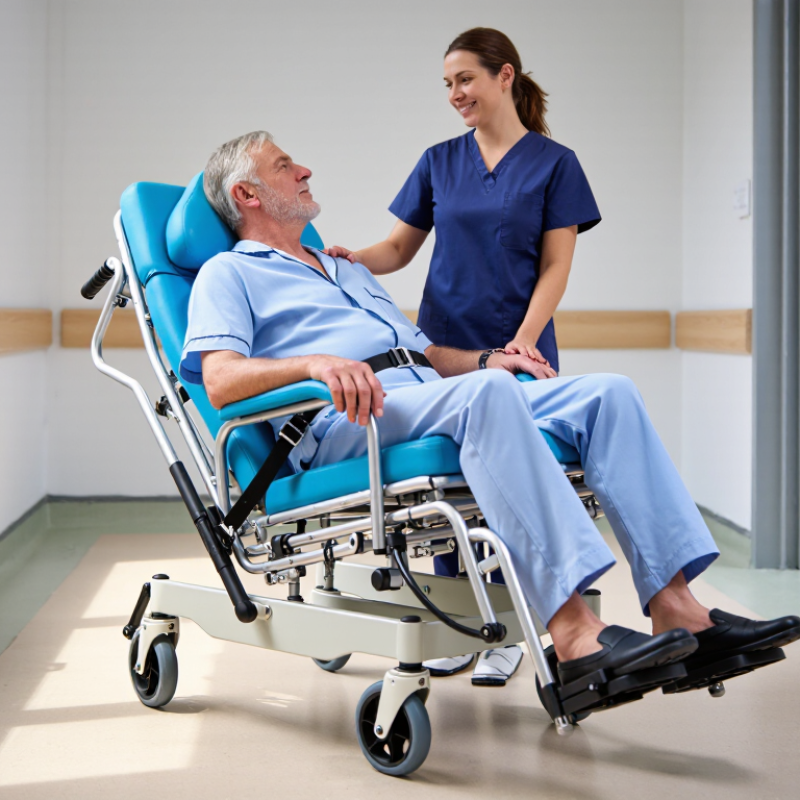
An aluminum patient transfer chair is a wheeled mobility device designed to move a seated patient between rooms, beds, bathrooms, and treatment areas. Its frame commonly uses aluminum because the material is lightweight, corrosion-resistant, and easy to maneuver. Typical features include swing-away footrests, armrests, locking casters, a safety belt, and a padded seat. The chair is not a substitute for a powered lift or a properly fitted wheelchair.
Its main purpose is controlled, short-distance transfer. A caregiver can position the chair beside a bed, lock the wheels, and support the patient during movement. This reduces unnecessary walking and may limit twisting or sudden weight shifts. The World Health Organization reported in its 2022 Global Report on Assistive Technology that more than 2.5 billion people need at least one assistive product. That figure shows why simple transfer equipment matters in daily care.
Safety depends on fit, training, and patient condition. OSHA guidance identifies manual patient handling as a significant source of musculoskeletal risk for healthcare workers. Aluminum alone does not make a chair safe. It can feel unstable if the seat is too narrow, the brakes are weak, or the user exceeds its rated capacity. I have seen equipment descriptions focus heavily on low weight, while overlooking seat height and transfer clearance. That is an important weakness. Staff should inspect brakes, belts, footrests, and frame joints before each use, then document problems instead of trusting appearance.

What Is an Aluminum Patient Transfer Chair?
Key Components and Design Features
An aluminum patient transfer chair is a compact mobility aid for short, controlled movement. It helps caregivers move patients between beds, bathrooms, and nearby seating. The lightweight frame reduces lifting effort. Aluminum also resists rust in humid care environments.
The frame should feel rigid, not loose. Check the welds, joints, and push handles before use. A padded seat supports comfort during brief transfers. Armrests may provide stability, but removable or swing-away designs allow easier side transfers. Footrests protect the legs and fold away when needed. Small details matter.
Swivel casters improve maneuverability in narrow rooms. Locking brakes help keep the chair steady during transfers. However, brakes are not a replacement for caregiver support. A safety belt can assist positioning, but it must never restrict breathing or cause discomfort. Seat width, seat height, and weight capacity should match the patient’s measurements.
Smooth, easy-clean surfaces support better hygiene. Yet, cleaning alone does not ensure safety. Inspect bolts, caster movement, and belt condition regularly. A lighter chair is not automatically better. Excessive lightness can affect stability, especially during uneven floor movement. In practice, the best design balances portability, support, and controlled handling.
An aluminum patient transfer chair supports short, controlled movement between beds, bathrooms, and other nearby spaces. Its frame stays light because aluminum combines strength with manageable weight. This matters when a caregiver must lift, steer, or store the chair several times daily. The seat, backrest, arm supports, and footrests create a stable sitting position. Many models include swing-away footrests, removable armrests, and a safety belt.
The transfer process starts with preparation. The caregiver checks the chair’s weight capacity, opens the brakes, and places it close to the destination. The user should sit fully back, with both feet supported. After positioning, the caregiver locks the casters before helping the person move.
During travel, pushing should remain slow and deliberate, especially across door thresholds or uneven flooring.
Small details matter.
Aluminum does not make the chair automatically safe. Lightweight frames can feel less substantial, particularly on sloped surfaces. That tradeoff deserves attention. Caregivers should inspect screws, wheel locks, footrests, and upholstery before use. A loose brake can change the entire transfer.
I would not rely on appearance alone. The chair must match the user’s mobility, balance, body size, and transfer ability. When uncertainty exists, a qualified healthcare professional can demonstrate a safer technique and confirm whether the chair is appropriate.
What Is an Aluminum Patient Transfer Chair?
Benefits and Limitations in Patient Mobility
An aluminum patient transfer chair is a lightweight mobility device designed for short-distance movement. A caregiver usually pushes it between a bed, bathroom, clinic room, or vehicle. Its aluminum frame resists corrosion and often weighs less than a steel alternative. That difference matters when lifting the chair into a car or positioning it beside a bed.
Small details affect daily safety. Locking casters, foot supports, padded armrests, and a supportive seat can reduce transfer difficulties. A narrow frame may pass through tight doorways. Smooth indoor flooring also allows easier steering. However, the chair does not remove the need for careful handling. The user may need assistance with balance, sitting, or standing. Never treat it as a self-propelled wheelchair unless its design specifically permits that use.
Limitations deserve equal attention. Aluminum can feel less substantial, although a well-built frame should remain stable within its rated capacity. The chair may perform poorly on gravel, steep ramps, thick carpets, or uneven thresholds. Brakes must engage fully before every transfer. The seat width, height, and weight limit should match the user’s body and movement needs. A lighter chair is not always easier. Some caregivers find it harder to control when a passenger shifts suddenly. A physical therapist or qualified healthcare professional can assess posture, transfer technique, and home hazards before regular use.
| Data Dimension | Typical Assessment | Relevant Information |
|---|---|---|
| Definition | Specialized mobility and transfer equipment | An aluminum patient transfer chair is a compact wheeled chair designed to help caregivers move a person over short distances and assist with transfers between locations such as a bed, bathroom, examination room, or wheelchair. |
| Primary Purpose | Short-distance patient mobility | It is generally intended for supervised transfers and indoor movement rather than independent long-distance travel or use as a full-featured self-propelled wheelchair. |
| Frame Material | Aluminum alloy | Aluminum provides a favorable strength-to-weight ratio and naturally forms a protective oxide layer. The frame may still be affected by dents, scratches, corrosion in harsh conditions, or damage from improper loading. |
| Typical Product Weight | Approximately 7–15 kg | The actual weight varies according to frame size, seat width, wheel configuration, brakes, armrests, footrests, and folding mechanisms. A lighter chair can improve handling but may include fewer features. |
| Common Seat Width | Approximately 41–51 cm | Common widths are designed for adult users, but the correct size must be selected according to the patient’s hip width, clothing, posture, and required lateral support. Always verify the manufacturer’s dimensions. |
| Typical Safe Working Load | Approximately 100–160 kg | Weight capacity differs significantly by model and configuration. The combined weight of the patient, clothing, medical accessories, and carried items should remain below the stated safe working load. |
| Mobility Method | Caregiver-propelled | Most transfer chairs have small rear wheels and push handles for caregiver control. They are usually not intended for effective self-propulsion because the wheel design and seating position prioritize compactness and maneuverability. |
| Maneuverability | Good in confined indoor spaces | A narrow frame and small turning radius can make the chair useful in corridors, bathrooms, elevators, and examination areas. Performance depends on floor surfaces, wheel size, occupant weight, and caregiver technique. |
| Transfer Support | May include swing-away or removable components | Swing-away or removable footrests and armrests can create more clearance during lateral or standing transfers. These features do not replace a transfer board, hoist, gait belt, or trained assistance when those are clinically required. |
| Braking System | Hand brakes and/or caster brakes | Brakes help stabilize the chair during transfers, but they must be fully engaged on a level surface before the patient sits down or stands up. Brakes are not a substitute for caregiver support or a proper transfer procedure. |
| Patient Positioning | Basic postural support | Typical features may include a backrest, armrests, footrests, a seat belt, and padded surfaces. Basic transfer chairs generally provide less adjustability and lateral support than rehabilitation or tilt-in-space wheelchairs. |
| Portability | Usually foldable or easy to transport | Many aluminum models fold for storage or vehicle transport. Before carrying or storing the chair, confirm that it is fully folded, locked as designed, and not supporting a patient. |
| Major Benefits | Lightweight, compact, and practical | Key benefits may include easier caregiver handling than heavier steel designs, reduced storage space, convenient indoor maneuverability, simplified bathroom access, and support for short supervised trips. |
| Limitations | Not suitable for every user or environment | Limitations can include reduced stability on uneven ground, limited shock absorption, restricted self-propulsion, less cushioning, lower adjustability, and reduced suitability for users who require extensive postural support or frequent long-distance mobility. |
| Terrain Suitability | Best on smooth, level surfaces | Indoor hard floors and accessible pathways are generally appropriate. Thresholds, loose gravel, steep slopes, wet surfaces, and uneven outdoor terrain can increase the risk of tipping or loss of control. |
| Safety Requirements | Supervised use recommended | Inspect the frame, fasteners, wheels, brakes, footrests, seat belt, and folding locks before use. Keep hands and feet clear of moving parts, avoid overloading, and follow the user manual and professional transfer guidance. |
| Cleaning and Maintenance | Routine inspection and cleaning required | Clean and disinfect surfaces according to the care instructions and infection-control requirements. Check wheel movement, brake function, upholstery, frame joints, and hardware regularly; replace worn or damaged parts promptly. |
| Best Use Cases | Temporary or short-distance assisted movement | Common applications include transfers to and from bathrooms, movement within healthcare facilities, transport during examinations, and use by patients who can sit upright but need caregiver assistance. |
| Poor Use Cases | Independent mobility or complex clinical transfers | It may be unsuitable for unsupervised use, prolonged seating, high-speed travel, steep ramps, rough outdoor terrain, users unable to maintain a safe seated posture, or transfers requiring powered lifting equipment. |
| Selection Priorities | Fit, capacity, safety, and environment | Evaluate seat width and depth, safe working load, overall width, folded dimensions, brake design, footrest clearance, patient posture, caregiver strength, transfer method, and the surfaces where the chair will be used. |
Important: Dimensions, weight limits, features, and safe-use instructions vary by model. A qualified healthcare professional should assess the patient’s transfer ability, posture, fall risk, and required level of assistance before selection or use.
What Is an Aluminum Patient Transfer Chair?
An aluminum patient transfer chair is a lightweight mobility device designed for short, supported transfers. It usually has a narrow frame, padded seating, arm supports, footrests, and locking casters. Aluminum resists corrosion and remains easier to lift than many steel alternatives. However, a lighter frame is not automatically safer.
Safety Guidelines and Selection Considerations
A trained caregiver should assess the user’s balance, strength, weight, and transfer ability before choosing a chair. Check the weight capacity carefully, including clothing, bags, and medical equipment. The seat should support the user without excessive pressure behind the knees. Too much width can reduce stability during movement. Too little width can cause discomfort and skin friction.
Engage the brakes before every transfer. Keep both feet clear of the casters and place footrests safely aside when appropriate. Never use the chair on stairs, steep slopes, or uneven flooring. A smooth bathroom floor can still become dangerous when wet. Inspect bolts, wheel locks, upholstery, and frame joints regularly. Loose parts need attention immediately. Clean spills promptly, especially near moving components.
Selection also depends on door width, storage space, and caregiver strength. Measure the narrowest doorway at home or in a facility. Consider adjustable supports when posture changes during the day. A chair with more features may seem better, but added parts can complicate maintenance. That detail is easy to overlook. Clinical guidance and the manufacturer’s instructions should influence the final choice, while actual trial fitting remains valuable.
Aluminum patient transfer chairs are wheeled mobility devices designed to move a seated patient over short distances. Aluminum has a material density of approximately 2.70 g/cm³, which is lower than stainless steel and can support a lighter frame design. Final chair weight, stability, and safe working load depend on the complete construction, not material density alone.

5960 Odana Road
Madison, WI 53719
T: 608.442.0032
1001 Frank H Street
Waunakee, WI 53597
T: 608-268-7140